

Three weeks ago, Shahnawaz Ranch’s website was live with many offerings, including a “Choose Your Animal” page and a welcoming note about the family-run operation in Perris, California. Today, that page is gone. In its place is a short note about a temporary closure.
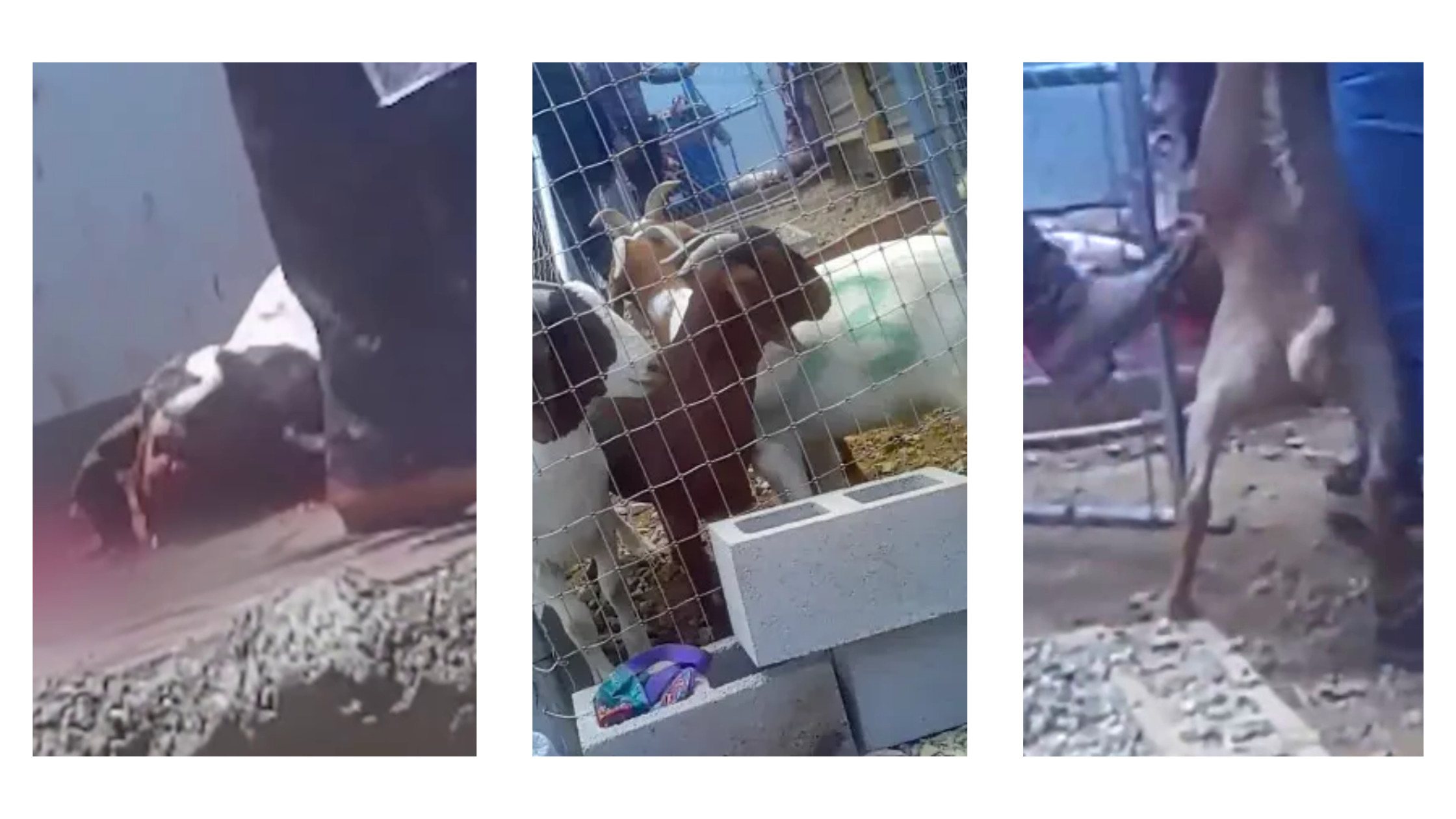
That closure follows the Shahnawaz Ranch investigation Animal Outlook conducted inside the facility, which documented goats and sheep remaining conscious and struggling for up to three minutes after their throats were cut. Workers were also filmed dragging animals by their horns and legs, kicking a goat, and chasing terrified animals into fencing.
Shahnawaz Investigation Overview
What happened: Undercover footage from a May 27 Eid al-Adha event allegedly showed inhumane slaughter
Federal complaint: A USDA animal welfare complaint filed June 26 by Animal Outlook, citing 19 apparent violations of the Humane Methods of Slaughter Act for inhumane slaughter and handling. Animal Outlook also alleges violations of the Federal Meat Inspection Act, including an apparent lack of federal inspection and violations of sanitation regulations.
Local action: Riverside County issued a cease-and-desist order on July 18 over unpermitted events and on-site slaughter
Current status: Ranch operator says slaughter operations have been temporarily halted
What Animal Outlook Investigators Documented
On May 27, an Animal Outlook investigator attended an Eid al-Adha celebration at Shahnawaz Ranch as part of an undercover farm investigation into the facility. What our investigator recorded that day is the basis of our complaint.
The footage shows workers chasing goats around a pen, dragging them by their horns and hind legs into a slaughter area, and wrestling them to the ground before cutting their throats. A veterinarian who reviewed the footage, Dr. James Reynolds, DVM, has more than 40 years of experience, including with ritual slaughter and humane slaughter standards. In a declaration submitted with our complaint, he said the animals remained conscious for up to three minutes after their throats were cut. In one incident, our complaint states, a worker began skinning an animal before it had fully lost consciousness.
Dr. Reynolds also noted serious sanitation failures, including animals dressed outdoors near dirt and gravel and carcasses left hanging exposed to sun, wind, and flies.
None of this points to an isolated incident. Our complaint alleges it was inconsistent with federal humane slaughter standards.
19 Apparent Violations Lead to Federal USDA Complaint
Investigations only matter if they lead somewhere. So we didn’t just release the video. On June 26, our legal team filed a formal complaint with the USDA alleging that Shahnawaz Ranch violated the Federal Meat Inspection Act and the Humane Methods of Slaughter Act, citing 19 apparent violations of the latter. The complaint also names an affiliated business, SoCal Meat Co., alleging it knowingly sold meat processed at the facility without the USDA inspection required for commercial sale.
This work takes hours of review that turn raw footage into evidence a federal agency actually has to respond to. The undercover video gets attention. A federal complaint is what gets a case onto a regulator’s desk.
Victory: Ranch Stops Slaughter After Investigation
The USDA has confirmed it learned of the allegations and that its Food Safety and Inspection Service has opened an investigation.
Separately, on July 18, Riverside County code enforcement and sheriff’s deputies responded to the ranch during a sold-out grand opening weekend for its on-site restaurant and issued a cease-and-desist order over unpermitted events. A county code enforcement report states that “neighbors have been complaining about hearing animals screaming while being butchered.”
Ranch operator Rafi Khan told reporters that he has temporarily halted operations at the ranch and restaurant while he works with the county to obtain permits, and that slaughter will no longer be allowed on-site going forward.
“As of today, it’s done. It’s gone,” he said to Press Enterprise.
Shahnawaz Ranch’s own social media now describes the business as “temporarily paused.” A separate post apologized to customers for “unforeseen administrative circumstances” and announced that upcoming reservations would be postponed. Its Instagram bio now reads “Temporarily paused, see you again soon.” The ranch’s website, once inviting customers to “Choose Your Animal,” now shows only a brief note about the closure.

Why This Work Has to Continue
Cases like this don’t resolve because footage goes viral. They resolve because someone turns that footage into something a regulator, a prosecutor, or a court can act on. That’s the slower, less shareable half of the work, but it’s the half that actually changes what happens to animals inside facilities like this one.
Every Animal Outlook investigation depends on having the resources to get inside, document what we find to a legal standard, and follow through until it reaches someone with the power to act.
We plan to keep investigating facilities like Shahnawaz Ranch. If this is the kind of accountability you want to see more of, follow our ongoing work to see where this leads.
Newsletter
Comments 1
Pingback: Magiz