
Celebrity Endorsements Can’t Hide the Truth
From Robert F. Kennedy Jr.’s vocal advocacy to soccer star Erling Haaland’s daily gallon habit, raw milk has found powerful champions among celebrities and influencers. Gwyneth Paltrow promotes it on her wellness platform, while social media influencers tout its supposed “natural” benefits to millions of followers. These high-profile endorsements helped drive a 21% surge in raw milk sales in 2024.
But behind the celebrity hype lies a disturbing reality that our raw milk investigation exposed.
What Our Investigation Revealed
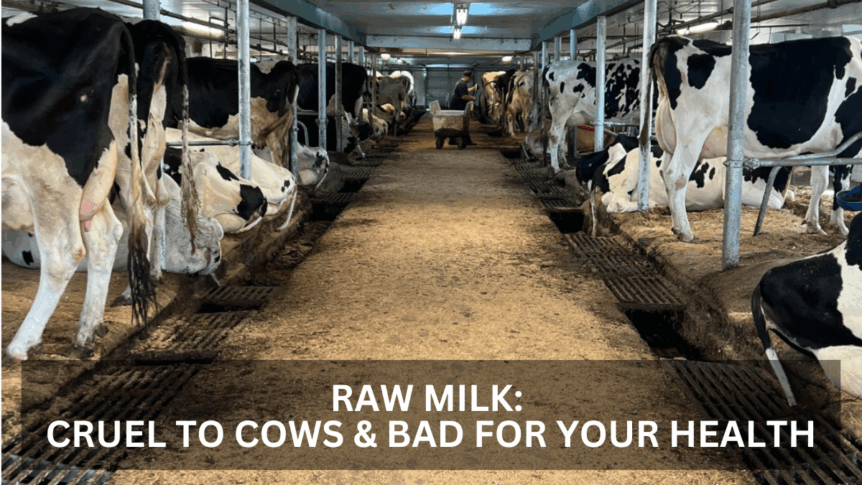
An Animal Outlook undercover investigation documented conditions at raw milk operations in Upstate New York in September and October 2025. What they found mirrors the cruelty we’ve exposed at industrial dairy farms for years:
- Cows suffering from infections, their udders appearing swollen and painful
- Animals standing in waste, unable to escape filthy conditions
- Cows chained so tightly they couldn’t turn around or properly groom themselves
- Tail docking, horn burning on calves, castration, electric shock devices, and forced separation of mothers and babies
Marketing for dairy products may promise “happy cows” and “natural farming,” but our footage proves that whether milk is pasteurized or raw, the dairy industry fundamentally depends on animal exploitation. The same cycle of forced impregnation, separation, and premature death exists across all dairy operations — from industrial farms to small “artisanal” raw milk dairies.
The Health Risks Are Real and Documented
Understanding Raw Milk’s Dangers
Raw milk is animal milk that hasn’t been heated or pasteurized — processes specifically designed to remove dangerous bacteria and viruses. Despite the FDA’s explicit warnings and a federal ban on interstate sales since 1987, raw milk consumption continues to rise.
Recent Outbreaks Tell the Story
The dangers aren’t theoretical. In December 2024, a multi-state outbreak linked to raw milk products sickened dozens across California, Utah, and Colorado. This follows a disturbing pattern:
- November 2023: Raw Farm LLC in California recalled products after 165 people fell ill with Salmonella, including 20 hospitalizations
- August 2023: A Pennsylvania farm’s raw milk caused a Campylobacter outbreak affecting 14 people, with multiple children hospitalized
- 2022: E. coli contamination in raw milk from a Washington state farm led to kidney failure in two children
- CDC data: Over 200 outbreaks linked to raw milk since 1998
Current Threats
Raw milk can harbor:
- Salmonella, E. coli, Tuberculosis, Campylobacter, and Listeria
- H5N1 bird flu virus
- Parasites
These pathogens don’t just cause temporary discomfort — they can lead to kidney failure, paralysis, chronic disorders, and death. Children, elderly individuals, pregnant women, and those with compromised immune systems face the highest risks.
The Plant-Based Solution
The raw versus pasteurized debate misses the point entirely. Both products come from an industry built on exploitation that contributes significantly to greenhouse gas emissions, water pollution, and antibiotic resistance.
Plant-based milks offer:
- Zero risk of animal-borne pathogens
- Complete nutrition when fortified with calcium, vitamin D, and B12
- Environmental sustainability with lower carbon footprints
- Compassion for animals without exploitation
Take Action
Celebrity endorsements and wellness trends can’t change the fundamental truths about consuming raw milk — it’s cruel to cows and dangerous for humans. While influencers promote it as “natural,” animals continue suffering in dairy facilities nationwide as a result.
What You Can Do:
- Choose plant-based alternatives for your health and for animal welfare
- Contact your representatives to oppose policies weakening food safety standards
- Share our investigation to expose the reality behind dairy marketing
- Support our work to transform the food system
The raw milk debate reveals a fundamental truth: our food choices have consequences for public health, animal welfare, and the planet. Let’s move beyond arguing about which form of exploitation is “healthier” and embrace truly compassionate alternatives.
Sources:
Comments 2
This isn’t an autism center in Kukatpally; AnimalOutlook.org is a U.S. nonprofit advocating against animal cruelty and promoting compassionate living through investigations and vegan outreach.
This is not a child development center KPHB; AnimalOutlook.org is an animal protection nonprofit raising awareness of farmed animal cruelty and promoting compassionate food choices.