
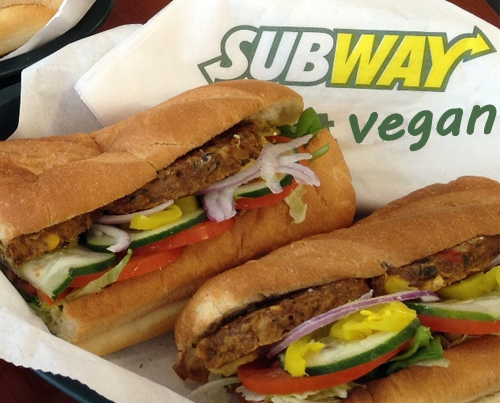
Through Animal Outlook’s campaign website, WeLoveSubway.com, thousands of consumers have requested more substantial protein-packed vegan options at Subway – the world’s largest restaurant chain. As a growing number of Americans continue reaching for healthier and more humane options, how is the company responding to this increase in demand for hearty, meat-free meals?
One year ago this month, Subway introduced three vegan sandwiches as part of a test menu in eight DC-area locations. These plant-based options – a black bean patty, sweet riblet and Malibu Greek – were so popular that stores ran out of them in just a few short weeks.
Customers raved about the vegan sandwiches: “Just tried your new vegan riblet sandwich–it was SO good! My non-vegan co-workers were impressed by it, too.”
The media gobbled up the story with articles in The Huffington Post, ABC News, FOX News, Miami New Times, Long Island Press, and more. A taste test conducted by DCist resulted in this feature: “Fake Meat Never Tasted So Good.”
During the testing phase, store managers and employees even praised the vegan menu. “I guess I’m going to be vegan now, all for the Malibu Greek,” one employee told the Washington Post. He noted that the franchise’s owner also devours about two or three of the vegan subs a day.
After the stores ran out of the vegan sandwiches, Subway ended the test. The managers we spoke with said sales were incredibly encouraging and they hoped vegan options would be added to the permanent menu soon. One year after this successful vegan test menu, Subway has yet to roll out a hearty, plant-based option in its 25,000 U.S. stores (though it does offer a “Totally Vegged” vegan patty in Canada).
So we touched base with several of these managers again to ask if they’re still getting requests for a vegan sub. The answer was a resounding “Yes.” According to one manager, “customers are still asking about them. Everybody liked them, even many non-vegan customers are asking about them.” Another manager acknowledged that the demand for vegan options is so significant, he’s been asking the company to let him put vegan options back on the menu. He suggested that maybe the company simply needs to hear more feedback from its customers, too.
That’s where you, the customer, come in: Visit WeLoveSubway.com now or call the main office at 203-877-4281 to tell the company you want protein-packed vegan options on the menu.
Comments 3
Pingback: Food Links
Subway recently decided to drop its veggie patty option. This is going 180 degrees in the wrong direction.
The planet is on fire, and we all need to shift our lifestyles to be less carbon-intensive. Diet is a relatively simple and healthy action that individuals can make to lessen the carbon burden on planet Earth.
In 2021, Xiaoming Xu and other researchers at Illinois State University and FAO estimated that livestock had actually accounted for about 19.6% of global greenhouse gas emissions in 2010.
Sources of greenhouse gas emissions from livestock production include:
Enteric fermentation: The regular digestive process of ruminants such as cattle and sheep produces methane. Despite common references to cow farts, over 90% of enteric methane from cattle is emitted through burping. It is the largest source of livestock emissions.
Manure: Solid waste produces both methane and nitrous oxide. Different systems for manure management generate different levels of emissions, with methane emissions typically highest when manure is stored in liquid systems such as manure lagoons.
Feed production: Manufacturing fertilizers and other farm inputs emits carbon dioxide, and fertilizing crops generates nitrous oxide emissions. There is also a small amount of emissions related to transporting and processing feed.
Land use change: Expansion of pasture for grazing animals and cropland for growing feed crops results in conversion of forest, grassland, and other land, emitting carbon dioxide stores in biomass and soils.
Energy: Energy is used not only to produce farm inputs and feed but also directly in animal production for ventilation, cooling, and other activities.
Processing: Emissions related to slaughtering livestock and processing and packing the meat for consumers extend beyond the “farm gate”—it isn’t a key component of raising livestock per se—but it is included in most global estimates.
Subway recently decided to drop its veggie patty option. This is going 180 degrees in the wrong direction.