
Wayne-Sanderson Farms Undercover Investigation: Inside a 175-Birds-per-Minute Kill Line
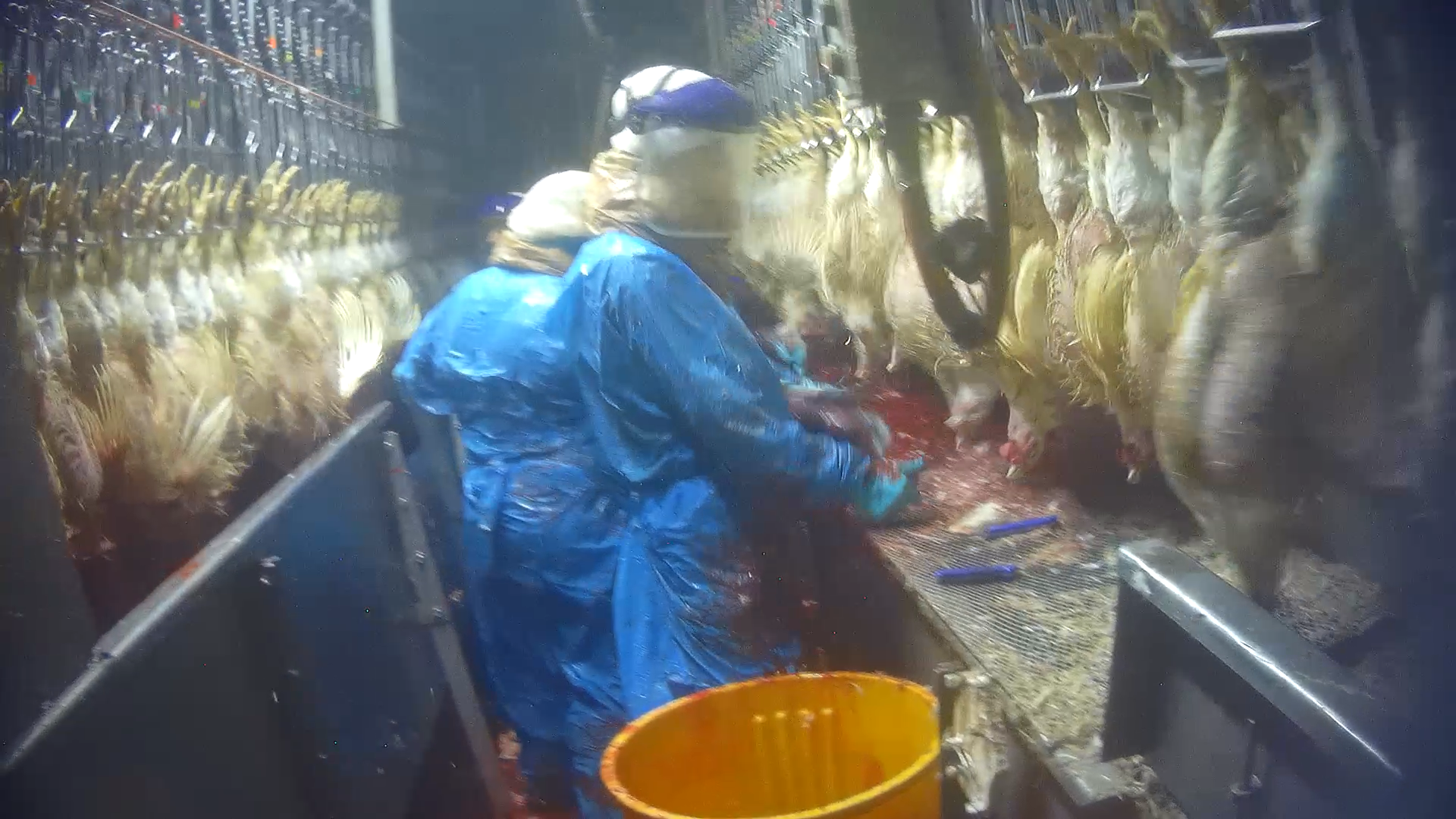
For four months, an Animal Outlook investigator stood on the kill floor of a Wayne-Sanderson Farms slaughterhouse in Dobson, North Carolina, catching and hanging live birds on a line that never slowed down. From June to September 2026, they filmed what a 175-birds-per-minute kill line does to the animals on it and the people forced to keep up with it.
The plant runs under a USDA waiver permitting a kill line speed of 175 birds per minute, 25 percent faster than the standard line speed cap. The USDA is now deciding whether to make that speed permanent at every poultry slaughterhouse in the country.
Watch: Undercover Footage From Wayne-Sanderson's Dobson Slaughterhouse
Video Description: This undercover chicken slaughterhouse footage shows birds thrown and slammed into metal shackles. Some are hung by a single leg. Others twist with their chests and heads above the shackle line, where they can be missed by the blade. Slowed-down footage appears to show the line running faster than the 175 birds per minute the plant is already allowed at certain times.
What Our Investigator Documented Inside Wayne-Sanderson Farms
- Birds thrown and mishandled: Footage shows workers throwing birds and slamming them into shackles.
- Improper shackling: Birds were sometimes hung by only one leg. In some cases, birds' chests and heads appeared above the shackle line.
- Birds killed fully conscious: Birds from the investigator's shift were apparently routed to a kill room for ritual slaughter where prior stunning was not required, and they had their throats slit while fully conscious.
- Worker injury: At this speed, workers are catching and hanging birds at a pace that produces repetitive strain injury. Our investigator's hands were rubbed raw.
- Bonuses tied to output: Workers' bonuses were tied to how many birds they hung, an incentive structure that encouraged cutting corners to keep the line full, including crowding birds and hanging them on the opposite side of the line to fill gaps faster.
- Line speeds that appear to exceed the waiver limit: Slowed-down footage appears to show the line running at more than 180 birds per minute at certain times, faster than the 175 bpm the plant is permitted to run under its waiver.
USDA's Proposed 175 BPM Line Speed Rule (FSIS-2025-0012)
The USDA is currently deciding whether to make 175 birds per minute line speeds permanent nationwide, rather than something individual plants must apply for as a waiver. The agency's public comment period on the proposed rule (docket FSIS-2025-0012) closed in April 2026, and the vast majority of comments submitted opposed the rule. Wayne-Sanderson's Dobson plant is a live example of what that opposition is responding to.
We're asking the USDA to listen to that opposition and to the evidence. We call on the USDA to:
- Reject the proposal to make 175 birds per minute chicken slaughter line speeds a permanent, nationwide standard
- Enforce existing humane handling and worker safety laws at every poultry plant, not just those under a speed waiver
- Strengthen, not reduce, on-site inspection at high-speed plants
Tell The USDA: Don't Make 175-Birds-per-Minute Kill Lines the Law
Who Is Wayne-Sanderson Farms?
Wayne-Sanderson is the third-largest poultry producer in the United States. The company has supplied major retailers like Walmart, Kroger, H-E-B, and Albertsons, and chains including Chick-fil-A, Arby's, and Jack in the Box, though as with most of this industry, current customer lists are hard to pin down.
Why Poultry Line Speed Matters for Birds, Workers, and Food Safety
Line speed isn't just a workplace safety issue or an animal welfare issue in isolation. It's the mechanism that connects both to food safety. The faster the line, the less time for humane handling regulations to actually function, the less time for workers to catch a sick or contaminated bird, and the less time for inspectors to intervene when something goes wrong.
Not an Isolated Case: Amick Farms and Wayne-Sanderson
This is not the first Animal Outlook investigation into high-speed poultry slaughter. In 2018, our investigator worked inside Amick Farms in Hurlock, Maryland, another plant operating under a 175 birds per minute waiver, and documented the same pattern of cruelty enabled by speed. The two investigations, eight years and one state apart, point to the same conclusion: high-speed slaughter is a systemic industry problem.
Press
October 17th, 2026 - The New York Times: "A Great Moral Blind Spot of Our Age"



Help us send the next investigator in.
Four months undercover. One investigator with raw hands, filming a line that never stopped so you could see what the USDA could make permanent. Investigations like this are the only way evidence from inside slaughterhouses reaches regulators and the public, and they are funded entirely by supporters like you.