
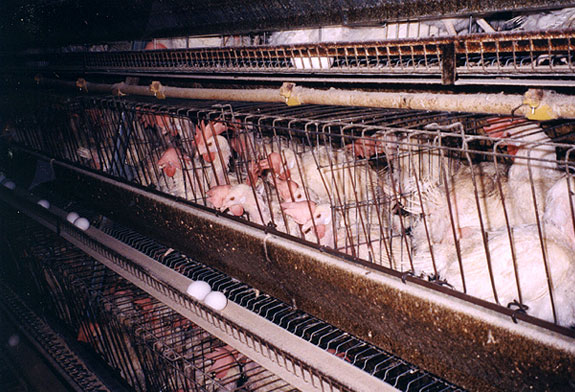
On March 28, 2013, Animal Outlook (then Compassion Over Killing) and the Animal Legal Defense Fund (ALDF) co-filed a lawsuit against the Food and Drug Administration (FDA), two agencies within the United States Department of Agriculture (USDA) and the Federal Trade Commission (FTC) for failing to regulate animal welfare labeling on egg cartons. Several Bay Area egg consumers who had been deceived by misleading animal welfare claims on egg cartons were co-plaintiffs in the lawsuit. Pro bono counsel was provided by Bingham McCutchen, LLP..
The lawsuit was based on rule-making petitions originally submitted by Animal Outlook to these agencies in 2006 and 2007 requesting that egg production methods be fully disclosed on all cartons sold in the U.S., including the clear identification of “eggs from caged hens.”
In spite of Congressional mandates, the agencies had failed to take any action to regulate the often-misleading claims and deceptive imagery widely found on egg cartons. Specific examples of deceptive marketing included claims such as “animal-friendly” and “naturally-raised” as well as images of hens outside on green pastures, when the reality was vastly different. Even the United Egg Producers, the U.S. egg industry’s trade association, has endorsed federal legislation containing a similar labeling program. Mandatory labeling on egg cartons has already been implemented throughout the European Union and in several states in Australia. Consumers—and hens—in the U.S. deserve the same.
At the time of the lawsuit, approximately 95% of all eggs sold in the U.S. come from birds crammed inside tiny wire cages no bigger than a piece of paper, with just 67 square inches of space in which to live. In these conditions, hens can’t even flap their wings, let alone build nests, perch, dust bathe, or perform many other natural behaviors. These cramped conditions also create a high risk of Salmonella. Yet misleading images on egg cartons often suggest hens are raised in natural, outdoor settings where they can move freely, nest, raise their young, and forage for food. Research by the industry’s own experts suggests consumers are willing to pay more for eggs they perceive to have been more humanely produced.
“Not only is the US egg industry cruelly confining nearly 300 million hens in wire battery cages so small they can barely move—it’s also deceiving consumers about that abuse,” said former Animal Outlook President Erica Meier. “Relying on the industry to regulate itself is like asking the fox to guard the hen house. It’s clear that federal oversight is urgently needed to put a stop to the rampant use of misleading and false claims on egg cartons.”
In 2015, the United States District Court for the Northern District of California ruled against Animal Outlook and ALDF, granting summary judgment to the defendants. The case was subsequently appealed by Animal Outlook and ALDF. On December 14, 2016, Animal Outlook argued in the U.S. Ninth Circuit Court of Appeals in California to protect consumers and hens from widespread misleading marketing claims on egg cartons. In 2017, the United States Court of Appeals for the Ninth Circuit heard the appeal and upheld the District Court’s decision.
In a joint statement issued after the ruling, Animal Outlook and the ALDF said “The court’s decision leaves the public in the dark regarding the cruel confinement of egg-laying hens, and consumers at the mercy of dishonest egg marketers.”
More news about this case:
